Should I hire a marketing agency? An honest guide
Should you hire a marketing agency, or work with a single growth partner? An honest, founder-to-founder guide to deciding what to buy and when.
If your business is growing and the marketing side is starting to feel like a second full-time job, the question “should I hire a marketing agency?” probably comes up every few weeks. It is a fair question, and the honest answer is, it depends on what you actually need. An agency is the right call in some situations and the wrong one in others, and the difference matters because growth help is expensive and slow to undo. If you want a shortcut, you can book a free discovery call and we will walk through your specific case together, but everything below you can think through on your own.
TL;DR: A marketing agency is best when you already have scale, an in-house lead, and one channel that needs real depth. A single growth partner is best when you are the expert in your craft, you are stretched thin, and growth is touching several channels at once. Pick the shape that matches your stage, not the one that sounds most impressive.
Why does the agency question keep coming back?
Because the alternatives all feel uncomfortable. Doing it yourself eats the time you should be spending on the work you are actually great at. Hiring in-house is a real commitment with payroll, management, and ramp-up. Hiring freelancers feels light, until you realize you are now the project manager for three different people. Against all of that, “just hire an agency” sounds like the grown-up move.
It can be. It also can be a quiet drain that takes a year to notice. The trick is to be honest about what you are buying before you sign anything.
What does a marketing agency actually do?
Most traditional marketing agencies are specialists. You hire one for paid ads, another for SEO, another for email, another for social or content. Each of those teams is good at their one thing, and each one runs its own playbook on its own timeline.
That structure works well at a certain stage. It also has a built-in cost that is easy to miss when you sign: you become the person stitching the strategy together. Every agency only sees their slice, so the picture of how the business actually grows lives in your head, and the channels can quietly start working against each other.
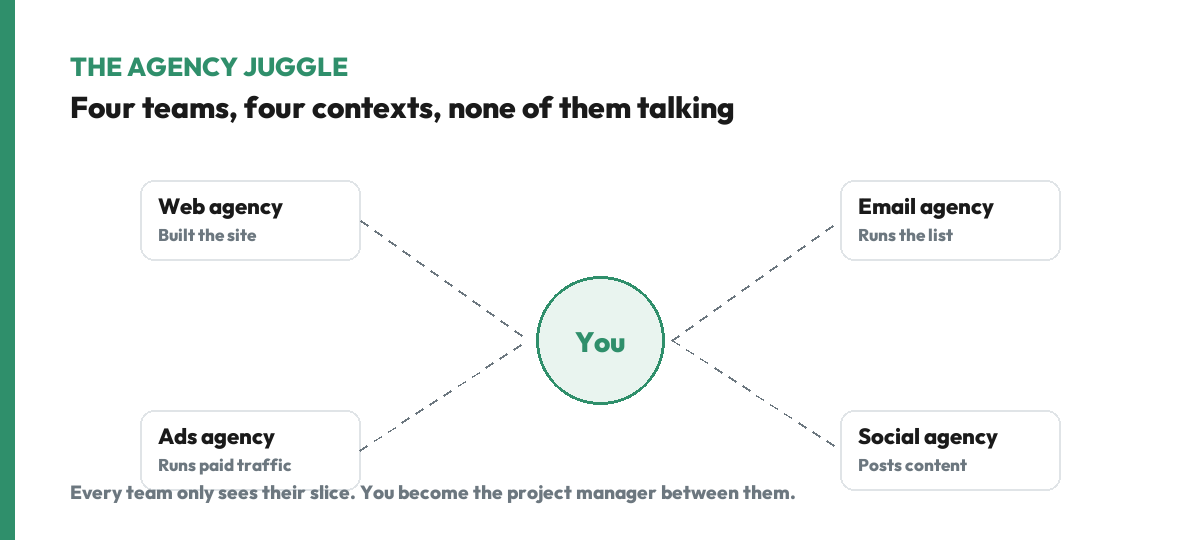
If you have a marketing lead in-house whose full-time job is to coordinate that, this is fine. If you are the founder and the lead, you have just bought yourself a new job: project manager between agencies who do not talk to each other.
Should I hire a marketing agency, or work with a single partner?
The cleanest way to answer this is to look at your actual stage, not at what the agencies pitch you. Two honest questions will get you most of the way there.
First, who is the strategy owner? If you already have a senior marketer in-house who owns the plan and just needs more arms and legs to execute it, specialist agencies are a good fit. They will run their channels well under your lead’s direction. If you are the strategy owner and you are also the operator and the salesperson and the founder, you do not need more channels to manage. You need someone to take growth off your plate.
Second, how many channels are in play? If one channel is doing all the heavy lifting (say a heavy paid budget, or a single SEO push), a specialist agency in that channel can make sense. If growth is touching your site, your email, your social, and your ad spend at once, splitting that across four teams creates more friction than it solves. One team with the full picture moves faster.
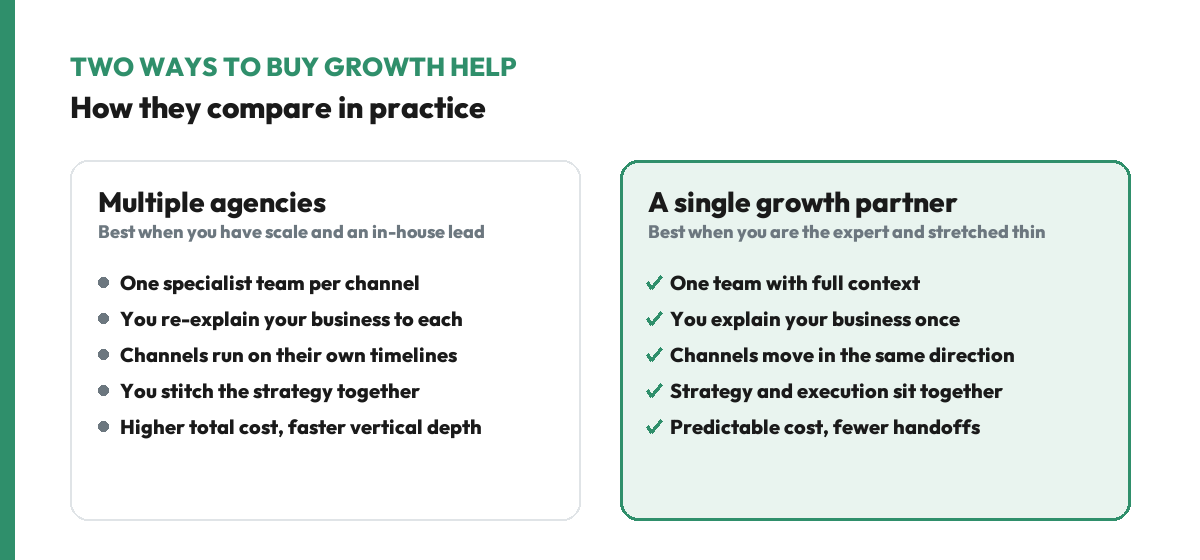
This is not an argument against agencies in general. Specialist agencies do real work and earn their keep when the conditions are right. It is an argument against hiring one because it sounds like the next step, before you have asked whether the conditions actually fit your business.
How to decide what to hire, in practice
If you want a simple way to make the call without spending three months researching it, here is the order we use with founder-led businesses:
- Start from the outcome. Decide what you want to be true in 90 days. More qualified calls. A clearer offer. A site that actually converts. The outcome is the brief.
- Map the gap. Look at what is between today and that outcome. Is it one channel that is broken, or is it the whole path from stranger to booked client? If you have not mapped that path yet, our piece on how to get more clients as a coach walks through the same idea in detail and applies just as well to any service business.
- Pick the shape that fits the gap. A single channel gap, with you (or an in-house lead) holding the strategy, points to a specialist agency. A whole-path gap, with you holding everything, points to a single growth partner.
- Buy outcomes, not activity. Whatever you hire, the contract should name the result and the timeline, not just the number of posts or hours. If a proposal cannot tell you what success looks like in 90 days, it is a retainer for activity, and activity is not growth.
The honest summary
Should you hire a marketing agency? Sometimes. The better question is, what shape of help actually matches the stage you are in? Specialist agencies are right when you have scale, a lead, and a single channel that needs depth. A single growth partner is right when you are the expert in your craft and stretched thin across a path that touches several channels at once. Pick the shape that fits the gap, not the one that sounds most impressive on a website.
If you would rather not figure that out alone, that is exactly what we take off your plate. Every partnership with The Growth Project starts with a free Growth Plan, so you can see the thinking before you commit to anything. Book a free discovery call and we will map yours together.
Frequently asked questions
When does it make sense to hire a marketing agency?
When you already have meaningful scale, a clear in-house lead to coordinate the work, and a specific channel you need real depth in (a heavy paid budget, a complex SEO migration, a brand campaign). Specialist agencies pay off when the strategy is set and the bottleneck is execution capacity in one place.
When does a single growth partner make more sense than an agency?
When you are the expert in your craft, your team is small, and growth is touching several channels at once. One partner with full context of your business moves faster than juggling separate teams, because the strategy and the execution sit in the same place and nothing gets lost between handoffs.
How much should a small business spend on marketing help?
There is no universal number, and any guide that gives you one is guessing. A safer way to think about it is to start from the outcome you want, work backwards to what it would take to get there, and only buy help that has a clear job tied to that outcome. Avoid retainers that bill for activity without naming the result.
What is a Growth Plan?
A short, written roadmap for your growth: where your gaps are, what to fix first, and what each move is meant to drive. At The Growth Project every partnership starts with one, free, so you can see the thinking before you commit to anything.
Want a clear roadmap for your own growth?
Every partnership with The Growth Project starts with a free Growth Plan. Book a discovery call and we'll map out yours together.