Email marketing for small business: a simple guide
Email marketing for small business, explained simply: why it beats renting an audience, the first emails to send, and how to start with a tiny list.
Most founder-led businesses treat email as an afterthought, something to set up later once everything else is handled. That is backwards. Email marketing for small business owners is the one channel you actually own, and for a founder who is great at their craft but stretched thin on the digital side, it quietly does more work than almost anything else. If you would rather walk through your own setup together, you can book a free discovery call and we will map it out. Otherwise, here is how to think about it from the start.
TL;DR: Email is the only audience you own, so it should be the first channel a small business gets right, not the last. Start by collecting the people who already know you, send a short welcome sequence that greets them and points to one clear next step, then keep a steady, useful newsletter going. You do not need a big list or fancy tools. You need a clear promise, a consistent cadence, and one obvious action in every send.
What is email marketing for small business?
Email marketing for small business is simply using email to turn interested people into clients, on a channel you control. It is two things working together. The first is a welcome sequence: a short set of emails that sends itself to each new person the moment they join, so nobody slips through the cracks. The second is a regular newsletter: a steady note you send to everyone, sharing something useful and reminding people you are there.
That is the whole idea. No clever tricks, no daily blasts. A small business that sends a thoughtful email every couple of weeks, and greets every new subscriber properly, is already ahead of most of its competitors.
The reason it works so well for founders is that it fits the way you already operate. You know your craft, you have opinions worth sharing, and you have people who would happily hear from you. Email is just the channel that carries that to them without anything sitting in the way.
Why email beats renting an audience
When you post on social, you are renting attention. The platform decides who sees you, and that can change overnight. You can spend a year building a following and still reach only a sliver of it on any given day. Your email list is different. It is yours, and it reaches the inbox directly.
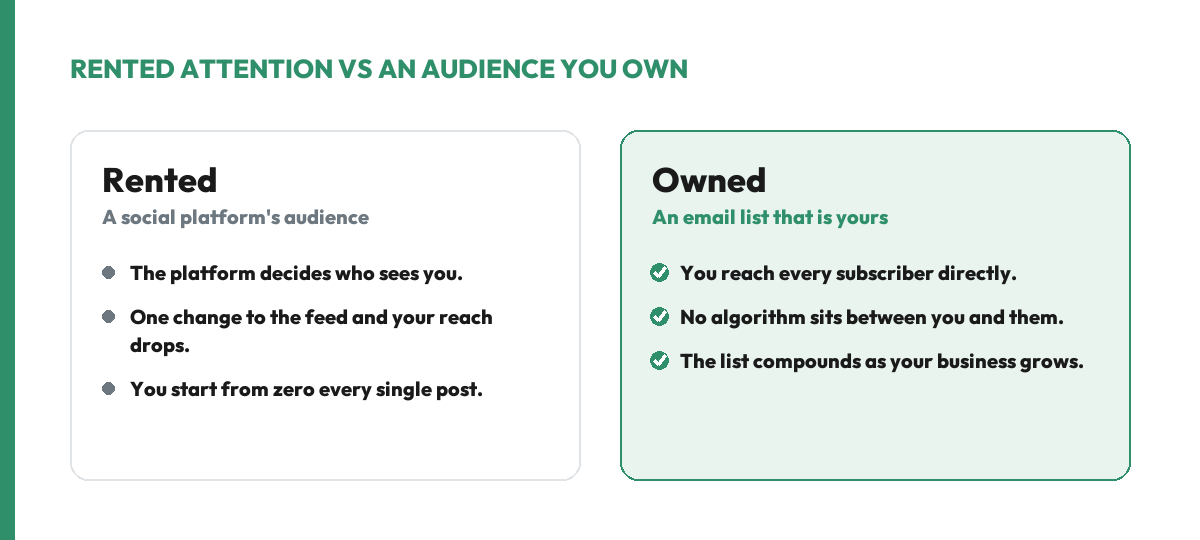
This is why we tell founders to build the list early, even while social and ads are doing their job. Every follower, every visitor, every person who books a call is someone you can stay in touch with for years, instead of hoping the feed shows you again next week. The list compounds. The rented audience resets.
It also pairs with the rest of your site. If you are working on a landing page that turns visitors into booked clients, the email signup is what keeps the people who were interested but not quite ready. They leave the page, but they do not leave your world.
The first emails every small business should send
If you do nothing else, set up a welcome sequence. These are the first emails a new subscriber receives, and they matter more than any single newsletter because the person is paying the most attention right after they join. A simple three-email arc works for almost any founder-led business.
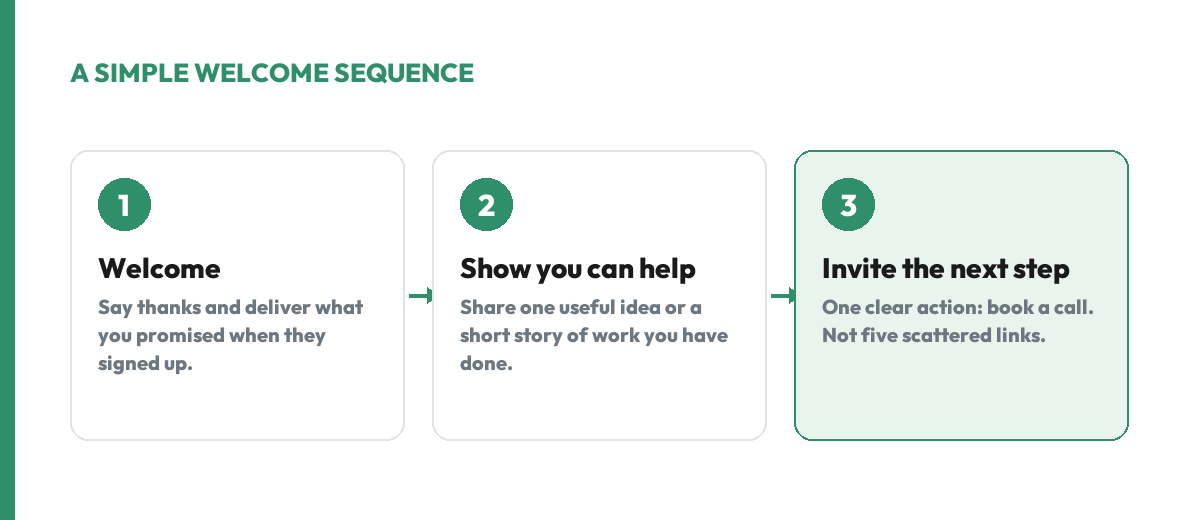
The first email welcomes them and delivers whatever you promised at signup, whether that was a guide, a discount, or simply your best advice. The second shows that you can actually help, with one useful idea or a short, honest story about work you have done. The third makes a clear, low-pressure invitation to take the next step with you.
Written once, this sequence greets every new person the same warm way, whether they join at noon or at midnight. It is the closest thing a small business has to being in two places at once.
What should those first emails actually say?
Plain, useful, and human. Write the way you would talk to one good client, not the way a brochure talks to a crowd. Skip the hype and the buzzwords. Make one point per email and make it clearly.
A useful rule: every email should either teach something or invite something, and ideally lean toward teaching. People stay subscribed because you are worth reading, not because you keep asking for the sale. When you do ask, ask for one thing. A single clear next step beats a paragraph of options every time, the same way a focused page converts better than a busy one.
Keep the subject line honest and specific. The job of the subject is to earn the open, not to trick it. If the email inside does not match the promise on the outside, people learn to ignore you, and an ignored list is worse than a small one.
How do you start with a small list?
You start with the people who already know you. This is the part founders skip, and it is the fastest win available. Past and current clients, people who have booked calls, friends of the business who always ask how it is going. They are warm, they trust you, and they are the easiest first subscribers you will ever get.
Add a simple signup to your site, ask in conversations, and mention it where you already have attention. You do not need thousands of subscribers to see results. A short list of the right people, treated well, books real calls. The same thinking that helps you get more clients without burning out applies here: reach the warm audience first, then widen out.
Resist the urge to buy a list or chase volume. A hundred people who want to hear from you are worth more than ten thousand who do not. Quality of attention is the whole game, and email rewards it more than any other channel.
A simple order to set it up in
If you are starting from nothing, build it in this order so you never get stuck. First, pick one place for people to sign up and give them a clear reason to do it. Second, write the three welcome emails so every new subscriber gets a proper greeting. Third, commit to a steady newsletter, even just twice a month, so the relationship stays warm. Only after those three are running should you worry about anything more advanced.
Hold one rule above the rest: every email points to one clear next step. Keep that discipline and your email does quiet, compounding work in the background while you stay focused on the craft you are great at.
Email marketing is one of the highest-return things a founder-led business can build, because it turns the attention you already earn into a relationship you own. If figuring out the digital side is pulling you away from the work you do best, that is exactly what we take off your plate. Book a free discovery call and we will map out your Growth Plan together, starting with the channel that should be working hardest for you.
Frequently asked questions
Is email marketing still worth it for a small business?
Yes, and arguably more than ever for a founder-led business. Email is the one audience you actually own. Social reach goes up and down with whatever the platform decides to show, but an email lands in the inbox of someone who already chose to hear from you. For a small business with a tight budget and not much time, that direct line is usually the highest-return channel you can build, because it keeps working long after you stop paying for attention.
How often should a small business send marketing emails?
Often enough that people remember you, rarely enough that you always have something worth saying. For most founder-led businesses that means roughly two to four times a month. The exact number matters less than the consistency. A steady, useful email every two weeks beats a flurry of five in one week followed by three months of silence. Pick a cadence you can actually keep and let the relationship build over time.
Do I need a big list before email marketing works?
No. A small, engaged list of people who know you will outperform a huge list of strangers almost every time. With a hundred of the right subscribers, you can book real calls and start real conversations. The goal early on is not size, it is fit. Focus on getting the people who already trust you onto the list and giving them a clear reason to take the next step.
What is the difference between a newsletter and an automated email?
A newsletter is something you write and send to everyone at once, like a regular note about what you are working on. An automated email is one you write a single time, then it sends itself to each new person at the right moment, like a welcome message the day someone joins. Most small businesses want both: a welcome sequence that greets every new subscriber, and a steady newsletter that keeps the relationship warm.
Want a clear roadmap for your own growth?
Every partnership with The Growth Project starts with a free Growth Plan. Book a discovery call and we'll map out yours together.