How do I know if my Facebook ads are working?
How do I know if my Facebook ads are working? The honest answer: the three numbers that matter, the vanity metrics to ignore, and when to kill a campaign.
A question we hear constantly from founder-led business owners is a nervous one: how do I know if my Facebook ads are working? Usually it comes from someone who has spent a few hundred dollars, watched the likes and reach tick up, and still cannot tell if any of it turned into a paying client. If you want to talk through your own numbers, you can book a free discovery call. Otherwise, here is the honest answer, without the dashboard-worship that most ad advice leads with.
TL;DR: Your Facebook ads are working only when they win paying clients for less than a client is worth to you. Likes, reach, and even clicks can all look healthy while nothing lands in your bank account. Follow the money in three steps: cost per click, cost per lead or booking, and cost per paying client. Compare that last number to what one client is worth over the time they stay. Give a campaign one to two weeks and enough spend to judge fairly, then keep it, fix the page behind it, or kill it. Most ads that look broken are fine; the page or offer after the click is the real problem.
How do I know if my Facebook ads are working?
Here is the short version: an ad is working when it brings you paying clients for less than a client is worth to you. That is the whole test. Everything Facebook puts in front of you, the likes, the reach, the little graphs that trend up and to the right, can feel like progress. Most of it is not the same thing as winning a client, and confusing the two is how founders convince themselves a losing campaign is a winner.
So be honest with yourself about what you can actually see. If you cannot trace a dollar of ad spend to a booked call or a signed client, you do not yet know whether the ads work, no matter how good the engagement looks. The good news is that the tracking you need is simple, and once it is in place the answer stops being a feeling and becomes a number.
The three numbers that actually tell you
The reason this feels murky is that Facebook shows you dozens of columns and none of them, on their own, answer the real question. You only need three, and they build on each other like rungs on a ladder.
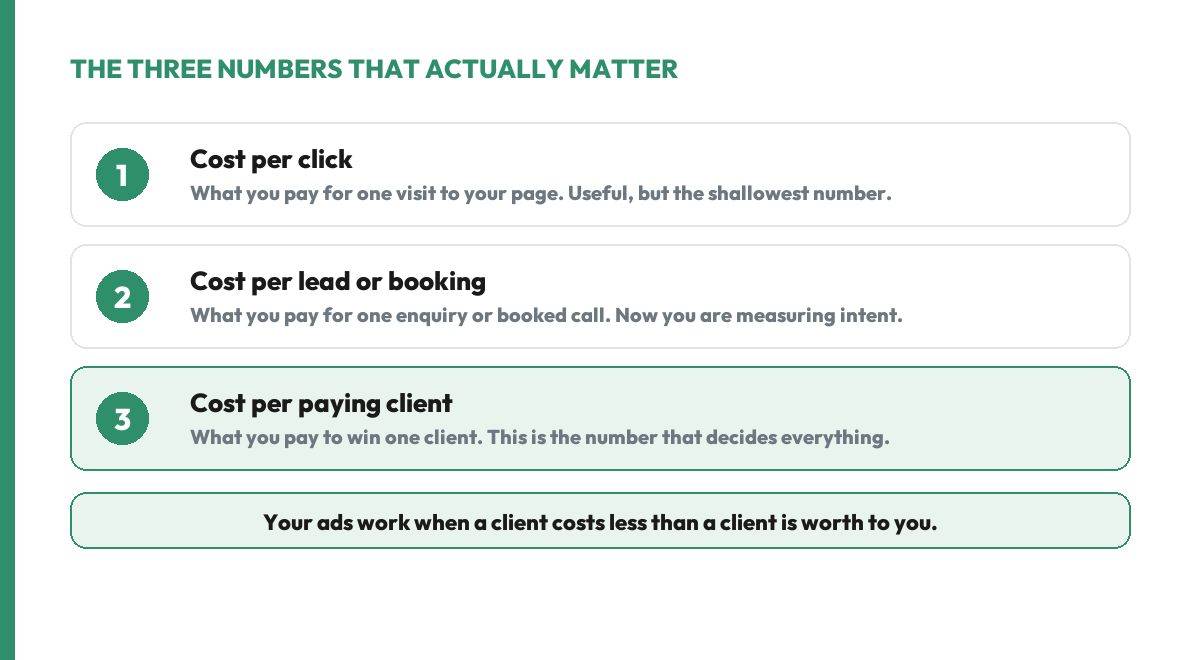
The first is cost per click: what you pay for one visit to your page. It is useful as a quick health check, but it is the shallowest number, because a cheap click that never buys is worth nothing. The second is cost per lead or booking: what you pay for one real enquiry or booked call. Now you are measuring intent, not just curiosity. The third, and the one that settles the argument, is cost per paying client: what you actually pay to sign one person who pays you.
Once you know that last number, the test is easy. Compare the cost of winning a client to what a client is worth to you over the time they stay. If you spend forty dollars to win a client who is worth four hundred, the ads are working and you should feed them. If you spend four hundred to win a client worth forty, no amount of clever creative will save that campaign. This is the same discipline behind deciding how much to spend on ads in the first place: the budget and the verdict both come from what one client is worth, not from a percentage or a vibe.
The metrics that lie to you
Plenty of numbers on that dashboard feel important and tell you almost nothing. Likes, reactions, shares, reach, impressions, and follower growth are all easy to grow and easy to fake yourself out with. They move whether or not a single client ever appears, and they are usually the first thing you see.
Even click-through rate, which sounds serious, only proves the ad caught someone’s eye. It does not prove that eye ever became a client. A post can be loved by thousands of people who will never pay you a cent. Watch cost per result as a rough health signal if you like, but make your real decisions on cost per lead and cost per paying client. If a number would not change what you do next, it does not deserve your attention.
Give it enough time to tell the truth
The most expensive mistake is judging an ad too early. On a small budget, the platform needs time and enough results to learn who to show your ad to, and the first day or two of numbers swing wildly before it settles. Founders who switch ads on and off every morning never give a campaign the chance to produce an honest answer, and they pay for that indecision.
Pick a modest daily budget you can sustain, give the campaign one to two weeks, and wait until you have a meaningful number of leads or bookings before you read the results. A verdict built on three clicks is not a verdict, it is a guess wearing a number.
Keep, fix, or kill
Once you have enough data, the decision is usually one of three, and knowing which one you are in saves you from both quitting too early and throwing good money after bad.
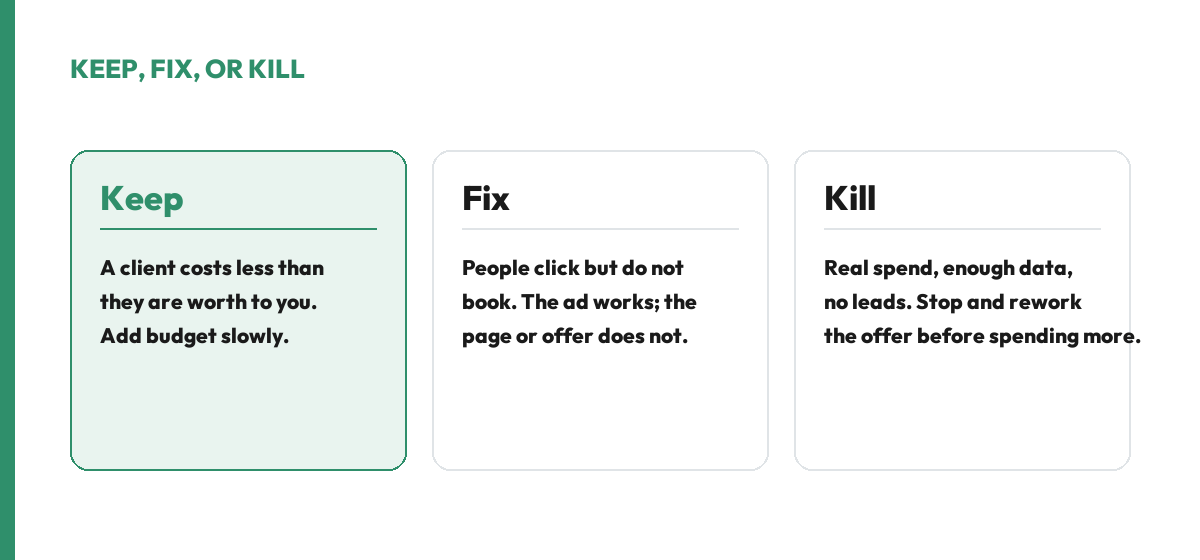
Keep is the happy case: a client costs you less than they are worth, so the ad is a machine that turns money into clients. Do not blow it up by scaling too fast; add budget slowly and watch that the cost per client holds. Fix is the most common case, and the most misread: people click but do not book. That almost always means the ad is fine and the problem is what comes after it, usually a landing page that does not convert or an offer that does not feel worth the next step. Kill is the honest ending for a campaign that has had real spend and enough data and still produces no leads: stop, and rework the offer before you spend another dollar.
That middle case is worth sitting with, because it catches so many founders out. When the numbers look bad, the instinct is to blame the ad and pour in more budget. More often you are simply pouring paid traffic into a leaky funnel, and the cheapest fix is not a better ad, it is a better page and a clearer offer behind it.
The simple answer
So, how do I know if my Facebook ads are working? Ignore the dashboard theatre and follow the money: what you pay for a click, then a lead, then a paying client, measured against what a client is worth to you. Give it enough time to be fair, then keep it, fix the page behind it, or kill it without regret.
If untangling this is pulling you away from the work you are actually great at, that is exactly what we take off your plate. When you want a clear read on whether your ads are earning their keep, book a free discovery call and we will map out your Growth Plan together, starting with the one change that will win you the most clients for the money.
Frequently asked questions
How do I know if my Facebook ads are working?
Your ads are working when they win you paying clients for less than a client is worth to you, and nothing else really settles it. Likes, reach, and even clicks can all look healthy while your bank balance does not move. The clean test is to follow the money one step at a time: what you pay for a click, what you pay for a lead or a booked call, and what you pay to actually sign a client. Then compare that last number to what one client is worth to your business over the time they stay. If a client costs you less than they bring in, the ads are doing their job. If you cannot see that far down the chain yet, the honest answer is that you do not know they are working, and the fix is to set up the tracking before you spend more.
How long should I run a Facebook ad before I judge it?
Long enough to collect real results, not real opinions. On a small budget that usually means one to two weeks and enough spend to produce a meaningful number of leads or bookings, not three clicks and a gut feeling. Judging an ad after a day or two is the most common and most expensive mistake founders make, because early numbers swing wildly before the platform has learned who to show your ad to. Pick a modest daily budget you can sustain, leave the campaign alone long enough to gather data, and only then read the numbers that matter. Turning ads on and off every day resets that learning and burns money without ever giving you an answer.
What Facebook ad metrics should I actually ignore?
Ignore the numbers that feel good but do not tie to revenue: likes, reactions, shares, reach, impressions, and follower growth. These are easy to grow and almost meaningless on their own, which is exactly why the platform shows them to you so prominently. Even click-through rate, which sounds serious, only tells you the ad caught attention, not that it earned a client. A post can be liked by thousands and sell nothing. Keep one eye on cost per result as a health check, but make your decisions on cost per lead and cost per paying client. If a metric would not change what you do next, it is not worth watching.
My ads get clicks but no clients. What is wrong?
That pattern almost always means the ad is working and something after the click is not. If people are clicking, your targeting and your message are doing their job of earning attention and intent. The breakdown is usually the page they land on or the offer itself: the page is slow, unclear, or asks for too much, or the offer does not feel worth the next step. Before you blame the ad or add budget, send that same traffic to a page built to convert and make the next action obvious and easy. Fixing the destination often turns a campaign that looked like a failure into one that quietly pays for itself, without spending a dollar more on the ads.
Want a clear roadmap for your own growth?
Every partnership with The Growth Project starts with a free Growth Plan. Book a discovery call and we'll map out yours together.