How much should I spend on ads for a small business
Wondering how much you should spend on ads for a small business? Set your budget from what a client is worth, then test small and scale what pays back.
How much should I spend on ads for a small business is one of the first questions a founder asks once the website is live and the word-of-mouth has plateaued. It is a good question, and most of the answers online get it backward. They hand you a percentage of revenue and send you on your way. That number is a ceiling, not a plan. If you would rather map your own numbers together, you can book a free discovery call. Otherwise, here is a simpler way to decide what to spend, one that protects your cash and still gives your growth room to move.
TL;DR: Do not start from a percentage of revenue. Start from what one new client is worth to you and what you can afford to pay to win one. That gives you a starting ad budget tied to a goal. Then spend it in a small, steady test for two to four weeks, measure the real cost of a lead or a booked call, and put more money only into what already pays back. Small and measured beats big and hopeful every time.
How much should I spend on ads when you are starting out?
The honest answer is: enough to learn something, and not a dollar more until you have. When you are starting out, the goal of your spend is not sales, it is information. You are buying an answer to a question, which is whether paid attention turns into booked clients at a price that makes sense for your business.
That reframes the whole budget. Instead of asking how much you can afford to spend in a month, you ask how much you need to spend to get a clear read. For most founder-led businesses that is a modest daily amount held steady for a few weeks, not a big one-off push. A small budget that runs long enough to teach you something is worth far more than a large one that burns out in a weekend and leaves you guessing.
Start from your goal, not a percentage of revenue
The percentage rules you see everywhere, two to five percent of revenue for one type of business, ten to twenty for another, are not wrong so much as beside the point. They describe what companies on average spend. They say nothing about whether a given campaign is worth running for you.
A better starting point works backward from a single number: what one new client is worth to you. Not the price of one session or one order, but what that relationship is worth over the time they stay with you. Once you know that, you know what you can comfortably pay to win one of them, and the budget almost sets itself.
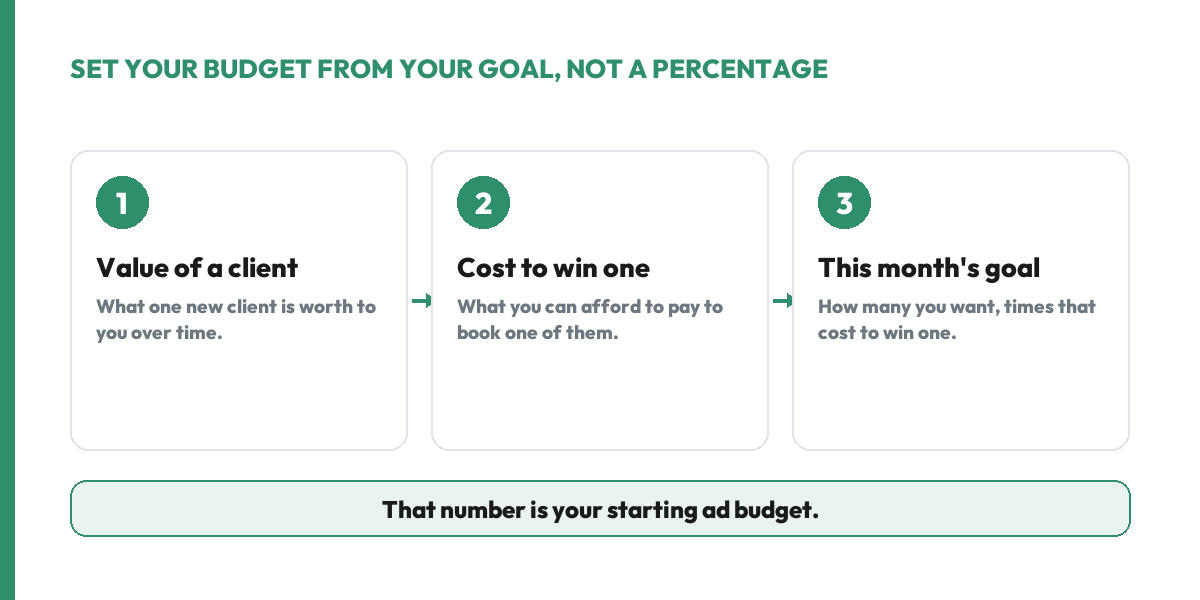
How do you set a budget from what a client is worth?
Take it in three plain steps. First, work out what one new client is worth to you over the length of a typical relationship. Second, decide what you can afford to pay to win one of them and still be glad you did. If a client is worth a few thousand dollars to you over a year, paying a fraction of that to acquire one is a good trade. Third, multiply that cost to win one by how many new clients you actually want this month. That figure is your starting ad budget, and unlike a percentage, it is tied to a result you care about.
This is also where a lot of ad money quietly leaks away, because the ad is only half the job. If the click lands on a page that does not make the next step obvious, you pay for the visit and lose the client. Before you spend anything, make sure you have a landing page that turns visitors into booked clients, or the budget you just calculated will underperform no matter how good the targeting is.
Test with a small budget before you scale
Once you have a number, resist the urge to spend it all at once. The smart move is to treat your first month as a test, not a launch. Run a small, steady daily budget, keep the offer and the audience consistent long enough to be readable, and watch what a lead or a booked call actually costs you.
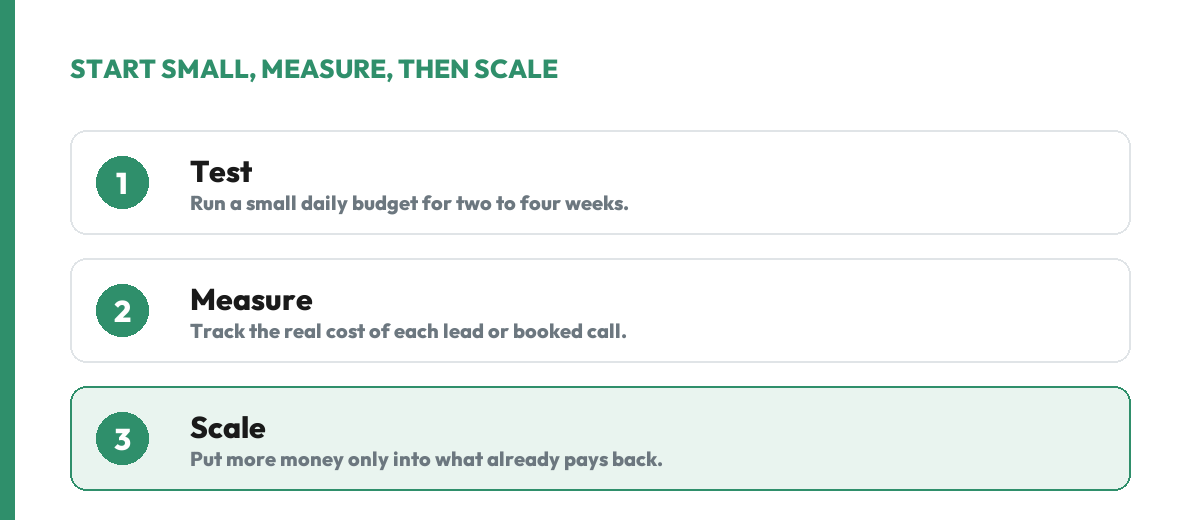
The rule that keeps you safe is simple: only scale what already pays back. If a campaign is winning clients at a cost below what one is worth to you, it deserves more money. If it is not, more money just loses faster. Most founders lose on ads not because they spent too little, but because they scaled something that was never working in the first place. A steady, measured test is the cheapest tuition you will ever pay.
What if you can only spend a little?
Then spend a little, well. A small budget is not a disadvantage if you point it at the right people with a clear offer. In fact, a tight budget forces the discipline that a big one lets you skip: you cannot afford a vague audience or a fuzzy message, so you sharpen both.
Paid ads are also not the only way to grow, and often not the first one. If your budget is genuinely tiny, the fastest wins usually come from the warm audience you already have and the referrals you are not yet asking for. The same thinking that helps you get more clients without burning out applies here: reach the people who already trust you first, prove the offer converts, and let paid ads pour fuel on a fire that is already lit rather than trying to start one from nothing.
Where ad money gets wasted, and how to avoid it
The three most common ways a small business wastes ad money are all avoidable. The first is spending before the page is ready, so clicks arrive and bounce. The second is judging results too early, killing a campaign on a bad day or scaling one on a lucky one. The third is chasing reach for its own sake, paying for views and likes that never turn into a conversation.
Avoiding all three comes down to keeping your eye on one number: the cost to win a real result, measured over weeks, against what that result is worth. Everything else is noise. If paid acquisition starts to feel like a full job on top of your real one, that is a fair signal to get help. Deciding whether to run it yourself or bring in a partner is its own question, and our honest guide on whether to hire a marketing agency walks through how to make that call without overpaying for it.
Spending on ads well is less about the size of the budget and more about the discipline around it. Start from what a client is worth, test small, measure honestly, and scale only what pays back. Do that and even a modest budget can grow a founder-led business steadily instead of draining it. If figuring out the numbers is pulling you away from the work you do best, that is exactly what we take off your plate. Book a free discovery call and we will map out your Growth Plan together, starting with what your ad budget should actually be.
Frequently asked questions
How much should a small business spend on ads to start?
Enough to get a real signal, and no more. For most founder-led businesses that means a small, steady daily budget you can run for two to four weeks without stress, often somewhere between ten and fifty dollars a day depending on your margins. The exact figure matters less than the discipline behind it: pick an amount you can afford to lose while you learn, keep it steady long enough to read the results, and only add more once you can see what a lead or a booked call is actually costing you. Starting small protects your cash while the ads teach you what works.
Is it better to set an ad budget as a percentage of revenue?
A percentage of revenue is a fine sanity check, but it is a poor place to start. It tells you what you can spend in total, not what a result is worth or whether a campaign is paying back. A better starting point is to work backward from the value of one new client and what you can afford to pay to win one. The percentage keeps you from overspending; the value-per-client math tells you whether the spend is actually working. Use the first as a ceiling and the second as your compass.
How long before ads start working?
Give any test two to four weeks before you judge it. The first several days are noisy while the platform learns who responds to your offer, so a single bad day tells you very little. Watch the cost of a lead or a booked call settle over a couple of weeks, not hours. If after a month the numbers are steady and a result costs less than a client is worth to you, you have something to scale. If not, change the offer or the audience before you change the budget.
Should I run ads myself or hire someone to do it?
If you have the time to learn and a small budget to test with, running simple ads yourself is a reasonable way to start and to understand your own numbers. The moment ads become a real line item, or the moment the learning is pulling you away from the work you are great at, it is worth getting help so the spend is managed properly. There is no prize for doing it the hard way. The right answer is whichever one gets you booked clients without eating the hours you should be spending on your craft.
Want a clear roadmap for your own growth?
Every partnership with The Growth Project starts with a free Growth Plan. Book a discovery call and we'll map out yours together.