Local SEO for service businesses: how to get found
Local SEO for service businesses, in plain English: how to get found on Google and Maps by the people nearby who are ready to book you today.
Local SEO for service businesses is how a plumber, a coach, a clinic, or a cleaner gets found by the people who live nearby and are ready to book. It is not about ranking everywhere for everything. It is about showing up in the small handful of results Google puts in front of someone searching in your area, at the moment they need what you do. If you would rather map your own plan together, you can book a free discovery call. Otherwise, here is how local search really works and the order to build it in.
TL;DR: Local SEO is winning the nearby searches that turn into booked work. Three things decide who shows up: how well you match the search, how close you are, and how trusted you look. Claim and complete your Google Business Profile first, keep your name, address, and phone identical everywhere, build one clear page for each service and area you cover, then ask every happy client for a review. Reviews are the single strongest lever most service businesses ignore.
What is local SEO for service businesses?
Local SEO for service businesses is the work of showing up in local search results: the map with a short list of businesses, the reviews under each one, and the pages that rank beneath them. When someone types “electrician near me” or “physiotherapist in my town”, Google does not show the whole internet. It shows a short, local list. Local SEO is how you earn a place on that list.
The difference from regular SEO is intent. A national blog wants readers from anywhere. A service business wants the person three miles away who is ready to call today. That person is far more valuable and far easier to win, because you are competing with a few nearby businesses, not the entire web.
Why getting found locally beats ranking everywhere
It is tempting to chase big, broad keywords. For a service business, that is usually a waste. Ranking on page two for a national term brings you visitors who will never become clients. Ranking in the local map for “near me” brings you someone in your area with their phone already in their hand.
Search volume matters less than search intent here. A term a few dozen local people search each month, all of them ready to book, is worth more than a popular term searched by people who live nowhere near you. Getting found locally is about being the obvious choice for a small, high-intent group, not the loudest voice in a crowd.
The three things Google weighs for local results
Google has said publicly that local results are decided by three factors: relevance, distance, and prominence. Relevance is how well your profile and pages match what someone searched for. Distance is how close you are to the searcher. Prominence is how well known and trusted you look, which reviews, mentions, and links all feed.
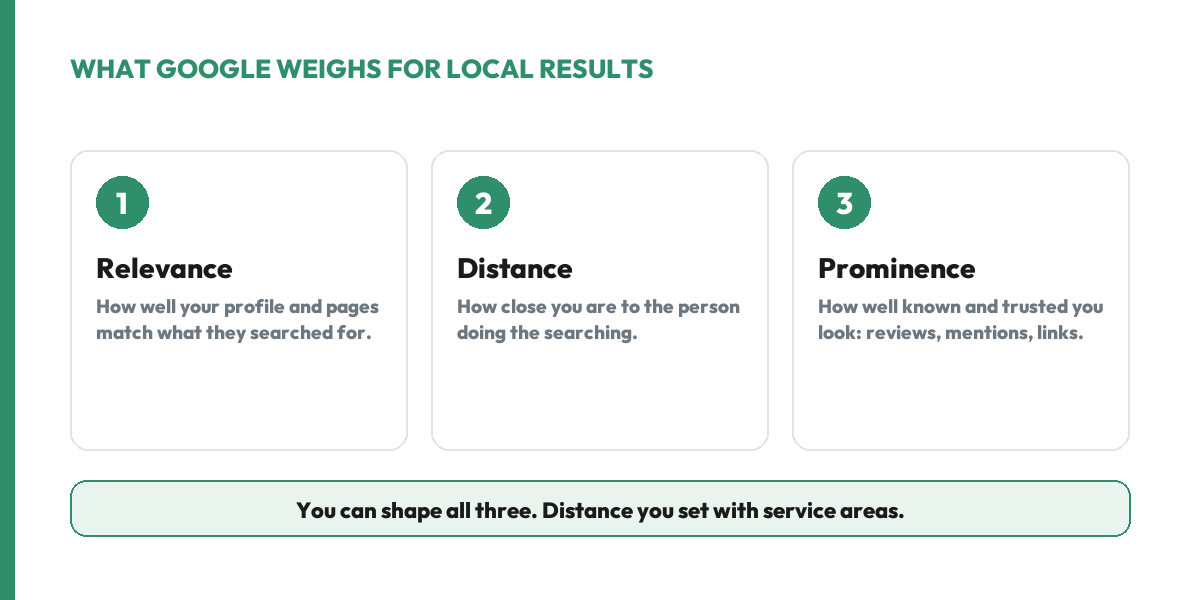
You cannot move your business closer to everyone, but you can shape all three. You set your service area so Google knows where you work. You make yourself relevant by describing exactly what you do and where. And you build prominence the slow, honest way, with steady reviews and a complete, accurate profile.
Start with your Google Business Profile
If you do only one thing this month, claim and complete your Google Business Profile. It is free, and it is what feeds the map results and the panel that shows your hours, phone, and reviews. A half-filled profile is the most common reason a good local business stays invisible.
Complete every field. List your real services, your hours, the areas you cover, and add real photos of your work. Choose the most accurate primary category, because that single choice tells Google which searches you belong in. Then keep it current, because an outdated profile quietly costs you calls.
How do you show up when neighbours search?
You show up by matching the search and earning trust, over and over. First, make sure your name, address, and phone number are written identically everywhere they appear online, from your own site to old directory listings. Google reads inconsistent details as a sign it might have the wrong business, and quietly holds you back.
Then give Google clear pages to rank. A single services page that lists ten things in one paragraph is weak. One focused page for each main service, and where it makes sense one for each town you serve, is far stronger. Each page should answer the question a local searcher is actually asking, which is the same discipline behind a landing page that turns visitors into booked clients.
Reviews are your local ranking engine
Reviews do double duty. They are one of the strongest prominence signals Google uses, and they are the first thing a human reads before choosing who to call. A business with forty recent, honest reviews will usually beat a better one with three.
The fix is a simple habit, not a big push. Ask every satisfied client for a review while the work is fresh, make it easy with a direct link, and reply to the ones you get. Never buy reviews or write fake ones, because it breaks Google’s rules and customers can smell it. Real, steady reviews compound, the same way word of mouth does when you get more clients without burning out.
What if you do not have a storefront?
Plenty of service businesses have no shopfront: mobile mechanics, home cleaners, trades, coaches who travel to their clients. Google supports this as a service-area business. You hide your street address and instead list the towns or regions you cover, so you appear for searches across your whole area rather than one fixed pin on a map.
The rest of the playbook is the same. Complete the profile, cover your services and areas clearly on your site, and gather reviews. If anything, service-area businesses win more from local SEO, because a well-run profile lets you compete across a whole region without renting space in every part of it.
A simple order to do this in
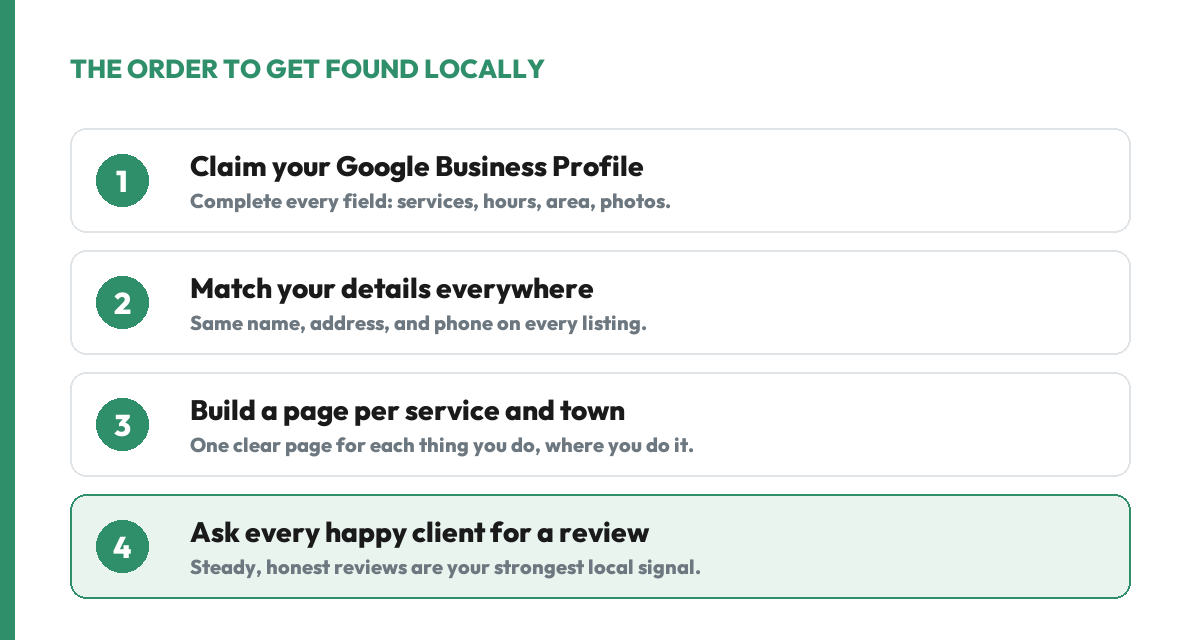
Local SEO rewards patience and consistency, not clever tricks. Do it in order and it stops feeling overwhelming. Claim and complete your Google Business Profile. Make your name, address, and phone identical everywhere. Build one clear page per service and area. Then ask every happy client for a review, and keep asking.
That sequence is enough to make most founder-led service businesses visible to the people nearby who are ready to buy. It is not fast, but it compounds, and unlike ads it keeps working after you stop paying. Deciding whether to run this yourself or bring in help is a fair question, and our honest guide on whether to hire a marketing agency walks through how to make that call without overpaying for it.
Getting found locally is one of the highest-return things a service business can do, because it puts you in front of demand that already exists in your own backyard. If sorting out the digital side is pulling you away from the work you are great at, that is exactly what we take off your plate. Book a free discovery call and we will map out your Growth Plan together, starting with how to get you found by the clients nearby.
Frequently asked questions
How long does local SEO take to work for a service business?
Plan for a few months, not a few days. Claiming and completing your Google Business Profile can lift your visibility within a couple of weeks, because that data feeds the map results quickly. The slower, more durable gains come from steady reviews and clear service pages, which build over three to six months as Google sees your business is real, active, and trusted in your area. The good news is that local SEO compounds: unlike an ad that stops the moment you stop paying, the profile, pages, and reviews you build keep bringing in nearby clients long after the work is done.
Do I need a website for local SEO, or is a Google Business Profile enough?
A complete Google Business Profile alone will get you into the map results and win real calls, so if you only have time for one thing, start there. But a website makes everything stronger. It gives Google clear pages to match against specific searches, it lets you explain each service in its own words, and it gives visitors somewhere to learn more and book. Think of the profile as your entry into local search and the website as what helps you rank beneath the map and convert the people who click through. Most service businesses do best with both, in that order.
How many reviews do I need to rank in the local pack?
There is no magic number, and chasing one misses the point. What matters is having more recent, honest reviews than the businesses you are competing with locally, and keeping a steady trickle coming rather than a single old burst. A business with forty reviews from the last year usually beats one with a hundred from three years ago. The habit that works is simple: ask every satisfied client for a review while the work is fresh, make it easy with a direct link, and reply to the ones you receive. Real reviews compound the same way word of mouth does.
Can I do local SEO myself, or should I hire someone?
The foundations are genuinely do-it-yourself. Claiming your profile, filling in every field, keeping your details consistent, and asking for reviews take time but not special skill, and doing them yourself teaches you how local search works. The moment it starts pulling you away from the work you are actually great at, or you want to move faster than your evenings allow, that is a fair time to get help. There is no prize for doing it the hard way. The right answer is whichever one gets you found by nearby clients without eating the hours you should spend on your craft.
Want a clear roadmap for your own growth?
Every partnership with The Growth Project starts with a free Growth Plan. Book a discovery call and we'll map out yours together.