How to write a welcome email sequence that converts
A welcome email sequence greets every new subscriber the moment they join. Here is how to plan, write, and send a four-email arc that books calls.
Most founders set up email and then skip the part that matters most: the very first emails a new subscriber ever receives from them. A welcome email sequence is the short run of messages that greets every new person automatically, right when their attention is highest. Get it right and it quietly turns curious subscribers into booked calls while you stay focused on the work you are great at. If you would rather map your own setup together, you can book a free discovery call. Otherwise, here is how to build a welcome email sequence that actually converts.
TL;DR: A welcome email sequence is a short set of emails that sends itself to each new subscriber, in order, the moment they join. Build a four-email arc: welcome and deliver, give a quick win, show you can help, then invite one clear next step. Keep each email to a single idea and a single action, send them a day or two apart, and write the way you talk. Set this up before you worry about anything fancier, because it greets people when they care most.
What is a welcome email sequence?
A welcome email sequence is a set of emails written once that sends itself, in order, to every new person who joins your list. The first one goes out the moment they sign up, and the rest follow over the next few days without you lifting a finger.
It is different from a newsletter. A newsletter is written fresh and sent to everyone at once. A welcome sequence is automatic and personal to timing: each subscriber moves through the same emails starting from their own day one. That timing is the whole point. The window right after someone joins is when they are most curious about you, and a good sequence meets them there instead of leaving them in silence.
If you want the bigger picture of how this fits with newsletters and list building, our guide to email marketing for small business covers the full channel. This post zooms in on the sequence itself, because it is the highest-return piece to get right first.
Why a welcome email sequence is worth building first
When someone hands you their email, they are telling you they want to hear more. The hours and days right after that are the warmest a subscriber will ever be. A welcome sequence is how you use that moment well, every time, even while you sleep.
It also does work that is hard to do any other way. It introduces you properly, sets expectations for what is coming, and gives people an easy first step to take with you. Skip it, and a new subscriber sits quietly until your next newsletter, by which point the spark that made them join has often faded.
This pairs with the rest of your funnel. If you have built a landing page that turns visitors into booked clients, the welcome sequence is what holds the people who were interested but not quite ready to book on the spot. The page earns the signup; the sequence earns the trust.
The four emails in a welcome email sequence
You do not need a long sequence. A simple four-email arc works for almost any founder-led business, with each email carrying one clear job.
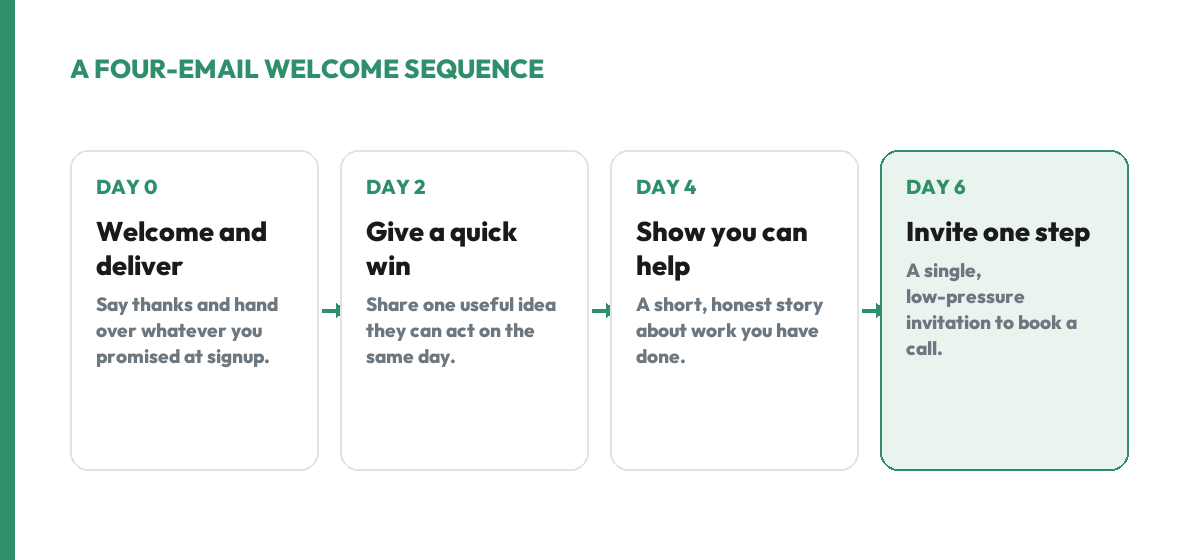
The first email welcomes the person and delivers whatever you promised at signup, whether that was a guide, a discount, or simply your best advice. Send it immediately. The second gives a quick win: one useful idea they can act on the same day, so they learn early that your emails are worth opening. The third shows you can help, with a short and honest story about work you have done. The fourth makes a single, low-pressure invitation to take the next step with you, such as booking a call.
Sent a day or two apart, this arc greets every new person the same warm way, whether they join at noon or at midnight. It is the closest thing a small business has to being in two places at once.
What should each welcome email actually say?
Plain, useful, and human. Write the way you would talk to one good client, not the way a brochure talks to a crowd. The structure of a single welcome email is simple, and holding to it is most of the battle.
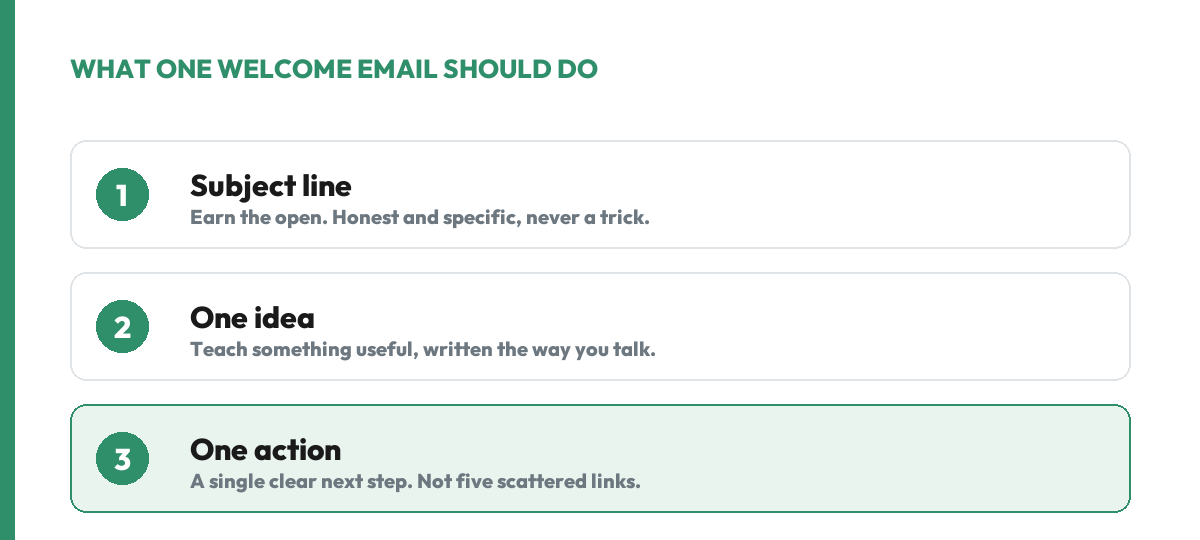
Start with a subject line that earns the open by being honest and specific. The job of the subject is to be worth clicking, not to trick anyone. If the email inside does not match the promise on the outside, people learn to ignore you, and an ignored list is worse than a small one.
Then make one point per email and make it clearly. A useful rule: every email should either teach something or invite something, and most should lean toward teaching. People stay subscribed because you are worth reading, not because you keep asking for the sale. When you do ask, ask for one thing. A single clear next step beats a paragraph of options every time, the same way a focused page converts better than a busy one.
How do you launch a welcome email sequence with a small list?
You start with the people who already know you. This is the part founders skip, and it is the fastest win available. Past and current clients, people who have booked calls, friends of the business who always ask how it is going. They are warm, they trust you, and they make the easiest first subscribers you will ever get.
Add a simple signup form to your site, ask in conversations, and mention it where you already have attention. You do not need thousands of subscribers for a welcome sequence to pay off. A short list of the right people, greeted well, books real calls. The same thinking that helps you get more clients without burning out applies here: reach the warm audience first, then widen out.
Resist the urge to buy a list or chase raw numbers. A hundred people who want to hear from you are worth more than ten thousand who do not, and a welcome sequence rewards that quality of attention more than any other email you send.
A simple order to build your welcome email sequence
If you are starting from nothing, build it in this order so you never get stuck. First, pick one place for people to sign up and give them a clear reason to do it. Second, write the four welcome emails so every new subscriber gets a proper greeting. Third, turn the sequence on in your email platform and test it by signing up yourself. Only after those three are running should you worry about anything more advanced.
Hold one rule above the rest: every email points to one clear next step. Keep that discipline and your welcome sequence does quiet, compounding work in the background while you stay focused on the craft you are great at.
A welcome email sequence is one of the highest-return things a founder-led business can build, because it turns the attention you already earn into a relationship you own. If figuring out the digital side is pulling you away from the work you do best, that is exactly what we take off your plate. Book a free discovery call and we will map out your Growth Plan together, starting with the emails that should be working hardest for you.
Frequently asked questions
How many emails should a welcome email sequence have?
For most founder-led businesses, three to five emails is the sweet spot. Four is a reliable default: one to welcome and deliver what you promised, one to give a quick win, one to show you can help, and one to invite a single next step. Fewer than three and you waste the moment a new subscriber is paying the most attention. More than five and you risk wearing out your welcome before you have earned it. Start with four, watch what people respond to, and adjust from there.
How far apart should welcome emails be sent?
A day or two between each email works well. The first should arrive immediately, while the person still remembers signing up. After that, spacing them every couple of days keeps you present without crowding the inbox. The whole sequence usually plays out over the first week to ten days. The exact timing matters less than the order and the fact that it sends itself, so nobody who joins ever gets silence.
What is the difference between a welcome sequence and a newsletter?
A welcome sequence is written once and sends itself to each new subscriber in order, starting the moment they join. A newsletter is something you write fresh and send to your whole list at the same time. The welcome sequence does the introducing; the newsletter keeps the relationship warm afterward. Most small businesses want both, and the welcome sequence is the one to build first because it greets people when their interest is highest.
Do I need special tools to set up a welcome email sequence?
No. Almost every email platform built for small businesses can send an automated sequence out of the box, usually under a name like flows, automations, or sequences. You do not need anything advanced to start. A signup form on your site, a simple platform, and four short emails written in your own voice are enough to have a welcome sequence working for you this week.
Want a clear roadmap for your own growth?
Every partnership with The Growth Project starts with a free Growth Plan. Book a discovery call and we'll map out yours together.